Aurora Botanicals · Branding · sample engagement
From kitchen labels to verified calm
+38% perceived premium · 14/14 SKUs on one system
The brief
Aurora Botanicals grew from a Portland farmers-market stall into a 14-SKU line — with labels still designed in a kitchen. The product earned premium prices; the shelf presence argued against them.
The brief: rebuild the identity without abandoning the aurora-arc motif loyal customers recognize, and give every future SKU a system instead of a one-off.
Success meant measurable lift in perceived premium and recall, zero off-system SKUs, and less label-reprint waste.
Constraints: Keep the recognized arc motif · recycled uncoated stock (220% ink limit) · 1-color fallback per label · 6-week timeline.
How it was made
-
Discovery
Eight PNW competitors mapped on the two axes that govern this purchase: clinical↔botanical and mass↔premium. The white space was unmistakable — premium botanical, with proof. The founder's customers already had the words for it: “verified calm.”
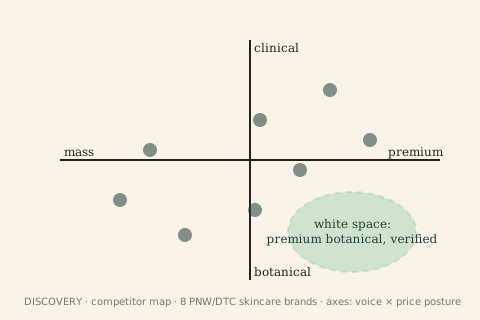
Competitor map — the white space Aurora can own. -
Strategy
Position: “Verified calm.” Voice: unhurried, precise, never mystical. The strategic move: certification stops being fine print and becomes a designed element on every label. Sign-off gate ① cleared before a single pixel of identity work.
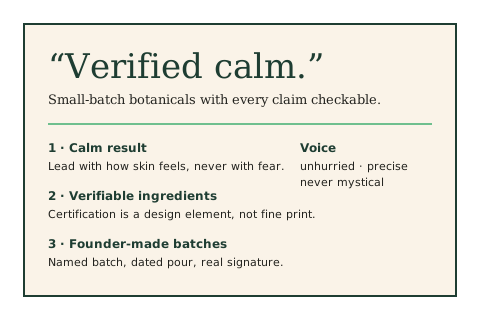
The positioning one-pager, as approved. -
Concept
Three genuinely different directions: Arc & Dawn, Leaf Seal, A-Horizon. The badge died at 12mm and read farmers-market cliché; the letterform read SaaS. Arc & Dawn kept the equity, survived the 1-color constraint, and stayed legible embossed.
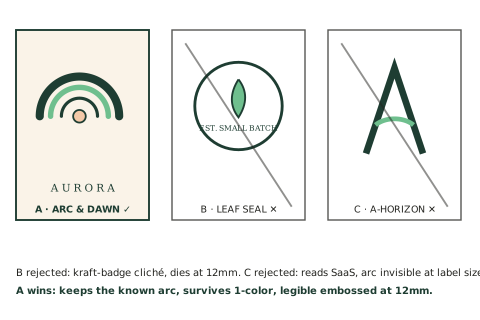
All three directions — rejections preserved, not hidden. -
Design
The system: graded arcs on a 4px grid over a dawn disc; evergreen, aurora, dawn and cream inks chosen inside the recycled-stock gamut; serif presence voice with a quiet ingredient sans. Clear space equals one disc diameter — easy to police, hard to fumble.
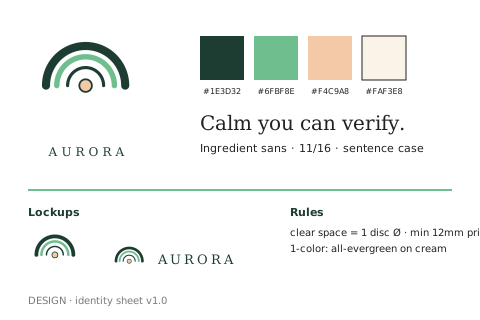
Identity sheet v1.0. -
Production
One label grid, three size classes, fixed zones: mark, SKU, verify panel. Ink coverage capped at 220% for uncoated recycled stock, dot-gain compensated, and every SKU proofed with a 1-color fallback — the spec that cuts reprint waste.
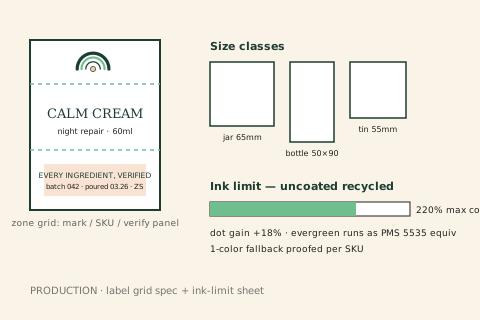
Label grid + ink-limit sheet. -
Results — how we measured
Measurement was designed before launch: a 40-person panel rated old and new shelf sets blind; recall ran as an unaided 24-brand lineup test; reprint waste came straight from the printer's quarterly run logs. The numbers land in the cards below — the method travels to every engagement.
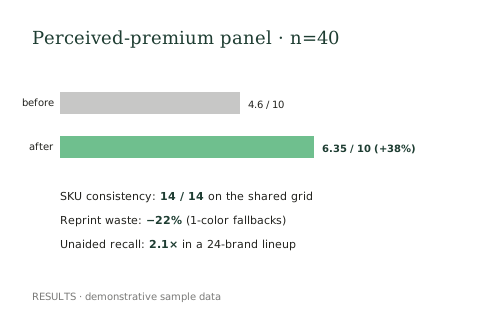
The panel instrument: blind before/after scoring (demonstrative).
The deliverable, live
This is the working deliverable itself — not a mockup of it.
Open full screen ↗Results demonstrative data
- +38%perceived premium (panel of 40)
- 14/14SKUs on one label system
- −22%label reprint waste
- 2.1×unaided recall (24-brand lineup)
“The arcs my market customers loved are still mine — they just grew up. Wholesale buyers stopped asking about price and started asking about shelf placement.”
Founder persona, Aurora Botanicals — demonstration quote
In the world
Where the system lives once it ships — shelf, hands, and street. photography in production